DBE Final Rule (September 2026)
On September 25, 2026, the Department published a DBE Final Rule in the Federal Register to remove the presumption of race and gender as qualifiers to the DBE program regulations. The following is updated overview of MARTA’s DBE Certification Program
What
are the criteria for DBE certification?
A Disadvantaged Business Enterprise or DBE is a small for-profit business concern that is at least 51 percent owned by one individual or at least two individuals who are both socially and economically disadvantaged. In the case of a corporation, 51 percent of the stock must be owned by one or more socially and
economically disadvantaged individuals. In addition, the business management and daily business operations are controlled by one or more of the socially and economically disadvantaged individuals who own it. The Disadvantaged Owner(s) must own 51 percent of the firm and there are No race or Gender Presumptions:
- DBE Conscious and DBE Neutral
Under the U.S. Department of Transportation (USDOT) Interim Final Rule (IFR), all firms currently certified through a Unified Certification Program (UCP) as Disadvantaged Business Enterprises (DBEs) must complete the required reevaluation process. The USDOT Issued a Final Rule (FR) on September, 25,
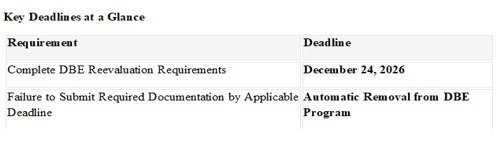
20226 instructing all Unified Certification Providers (UCP) to complete firm reevaluations no later than December 24, 2026.
Final Rule
Under the Final Rule, each UCP must complete its reevaluation process by December 24,
2026. A UCP may request a one-time extension of up to 90 days from the
Office of Small and Disadvantaged Business Utilization (OSDBU), provided the
request is submitted before the reevaluation deadline and OSDBU determines that
good cause exists. After completing the reevaluation process, the UCP must report its results to OSDBU, including any firms that failed to submit the required reevaluation documentation.
For firms certified through the Georgia Unified Certification Program (GUCP), failure to respond to a reevaluation request or failure to submit all required documentation by the applicable deadline will be issued a written notice and of nonresponse. This will result in automatic removal from the DBE Program without
further administrative proceedings, as required under the FR.
The
following from the Final Rule of April 9, 2024, remains unchanged:
The complete list of eligibility requirements for DBE certification is stated in 49 CFR, Part 26 and can be viewed online at
https://www.transit.DOT.gov/dbe. The following six
requirements must be proved by a DBE applicant; please note that these do not
cover all the requirements found in 49 CFR, Part 26.
Social
and Economic Disadvantage: A DBE owner must be a U.S. Citizen (or resident alien) and meet the federal definition of socially and economically disadvantaged as defined in 49 CFR Part 26.67. Individuals must be found to be socially and economically disadvantaged on a case-by-case basis.
Personal
Net Worth: The US Department of Transportation requires proof that participating DBE owners have a net worth not exceeding $2,047,000. When an individual's net worth exceeds the $2,047,000 threshold, the individual is no longer eligible to participate
in the DBE Program. Net worth excludes the value of the business and the primary residence of the owner.
Business
Size Standard: The DBE firm (including affiliates) must be a small business as defined by the Small Business Administration (SBA). Its annual gross receipts for the three previous fiscal years cannot have exceeded $30.72 million (or $56.42 million
for airport concessions in general with some exceptions). (1) Banks and financial institutions. $1 billion in assets; (2) Passenger car rental companies. $75.23 million average annual gross receipts over the firm's previous five fiscal years; (3) Pay telephones 1,500 employees; and (4) New car
dealers. 350 employees. Depending on the type of work the business performs, other size standards may apply.
Ownership: The DBE must be a small for-profit business concern where socially and economically disadvantaged individuals own at least 51 percent interest and control management and daily business operations.
Independence: The DBE must not be affiliated with another firm in such a way as to compromise its independence and control. Independence should be achieved in areas including, but not limited to, personnel, facilities, equipment, financial and/or bonding support, and other
resources.
Management
and Control: The DBE owner (s) must possess the power to direct or cause the direction of the management and policies of the firm and to make day-to-day decisions, as well as long-term decisions on matters of management, policy and operations.
What
does the certification process involve?
The application for the certification is first reviewed to ensure all information is complete. If all required documents from the checklist are submitted as required, the application is assigned to a MARTA Certification Analyst who reviews the file and schedules and conducts a site visit to the business. Based on all submitted
information and the site visit, the Certification Analyst issues a recommendation to accept or deny the application for DBE eligibility. If your firm’s application is approved, a Certification Letter is issued to the applicant. If your firm is denied certification, the applicant is given an opportunity to
appeal the denial.
MARTA handles certification for Fulton, DeKalb and Clayton Counties ONLY. GDOT our Unified Certification Partner handles all other counties in Georgia as well as Interstate DBE Applications.